
Queensland enters 2026 at a crossroads, navigating global disruption, a tight labour market, and a once-in-a-generation infrastructure pipeline that demands bold, coordinated action across government and industry. The QLD Policy Leaders’ Forum brought together senior representatives from manufacturing, agriculture, tourism and property to assess the risks and opportunities facing the state.
The discussion revealed a striking consensus: Queensland’s economic fundamentals are strong, with record capital interest, a growing population and a clear runway to 2032 and beyond. However, the state’s ability to capitalise on these advantages hinges on resolving critical workforce shortages, cutting regulatory red tape, addressing insurance affordability and accelerating housing and infrastructure delivery. The panel emphasised that 2026 is the year to act - before a compressed electoral and events calendar from late 2027 onwards narrows the window for meaningful reform. Across every sector, the message was clear: Queensland has the opportunity, the partnerships and the momentum, but converting that potential into tangible outcomes for Queenslanders requires urgency, collaboration and a willingness to do things differently.
Proudly Sponsored by:

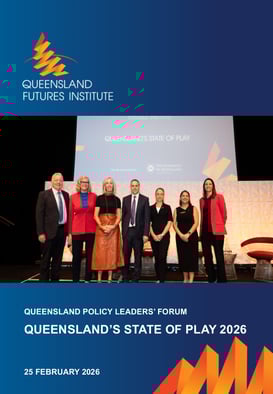

PANELLISTS:

JESS CAIRE
Queensland Executive Director
Property Council of Australia

NIKI FORD
Chief Executive Officer
AgForce Queensland

MICHELLE FARQUHAR
Head – Queensland
Australian Industry Group

NATASSIA WHEELER
Chief Executive Officer
Queensland Tourism Industry Council

MODERATOR:
PROF. BRENT RITCHIE
Academic Dean and Head of School
UQ Business School
SUMMARY OF KEY THEMES
- Workforce shortages are the number one constraint across all sectors, with 75% of Australians identifying a skilled and adaptable workforce as the top national reform priority.
- Queensland’s labour market is exceptionally tight, with slim margins and intense wage pressures compounding skills gaps in construction, agriculture, tourism and manufacturing.
- The agricultural sector is reeling from widespread flooding - with over 100,000 head of cattle lost, 3,000 kilometres of fencing destroyed and multi-year income impacts for producers who have been flooded up to three times since 2019.
- Insurance affordability has reached a crisis point for tourism and events operators, with premiums increasing by up to 500% over five years and many businesses choosing to operate uninsured or to cease operations entirely.
- Queensland’s property sector is attracting record institutional capital interest, but outdated tax settings and infrastructure bottlenecks risk undermining the state’s competitive advantage over Victoria and other states.
- A $2 billion residential activation fund is unlocking new housing supply, but sustained investment and extension to industrial land are needed to maintain momentum.
- Modern methods of construction and technology adoption can accelerate delivery, but the government must lead the way through procurement to build a viable private-sector pipeline.
- Artificial intelligence and digital transformation are accelerating across enterprises but change management capability and leadership bench strength remain the critical bottleneck.
- Mental health in regional communities is a significant and growing concern, compounded by repeated natural disasters, rising debt loads and slow disaster recovery processes.
- Skilled migration, delivered responsibly and with social cohesion, is essential to closing workforce gaps that domestic training alone cannot fill.
KEY PRIORITIES FOR STAKEHOLDERS
Workforce is the defining challenge of 2026
Across every sector represented at the forum - from manufacturing and construction to agriculture and tourism - workforce shortages emerged as the single most pressing constraint on Queensland’s growth. Recent national research presented to industry leaders found that 75% of Australians ranked a skilled and adaptable workforce as the number one priority for national reform, ahead of inflation, tax reform, housing and immigration. The forum heard that Queensland’s labour market is exceptionally tight, with slim margins and intense wage pressures placing significant strain on businesses of all sizes.
The discussion highlighted that the nature of work is shifting rapidly. Enterprises are accelerating their adoption of technology and artificial intelligence to improve productivity, while simultaneously easing investment in training and skilling - a trend that risks leaving the workforce unprepared for the disruption ahead. Major employers are already undertaking enterprise-wide reviews of how every role will evolve in the near term. The panel identified an urgent need for the training system, across universities and the vocational education and training (VET) sector, to respond to this new reality. Jobs and Skills Australia has indicated that 90% of new jobs over the next five years will require a degree, VET qualification, or both.
The three Ds: decarbonisation, digitalisation and disruption
The forum framed Queensland’s operating environment through the lens of three converging forces - decarbonisation, digitalisation and disruption. Of these, digitalisation and disruption were identified as the most dominant themes for 2026. Geopolitical volatility, trade uncertainty around tariffs and the accelerating integration of artificial intelligence into workplaces are reshaping how Queensland businesses operate, plan and invest. The panel emphasised that navigating this disruption requires both leadership and practical support for businesses, particularly as many small and medium enterprises are only beginning to engage with digital transformation.
IMPLICATIONS FOR GOVERNMENT
Cutting red tape to unlock productivity
Regulatory burden was a recurring theme across all sectors. The agricultural sector faces an estimated 88 separate pieces of regulation that producers must comply with daily - almost three times the regulatory load faced by a typical small to medium enterprise. The forum heard calls for a fundamental reduction in red tape to enable producers and businesses to focus on their core operations. In the property sector, 30 years of underinvestment in enabling infrastructure has created significant bottlenecks that are slowing the delivery of new housing, industrial land and commercial developments across the state.
Disaster recovery reform
The panel highlighted significant shortcomings in the government’s disaster recovery processes. While the speed of initial response has improved since the 2019 floods, the conditions attached to recovery funding have become more bureaucratic. The instant cash payment available to flood-affected producers was reduced from an unconditional $70,000 in 2019 to a staged process requiring multiple rounds of documentation - an onerous burden for producers who have lost everything and may lack reliable internet access. The forum called for a rapid, streamlined funding model that gets resources to affected communities as quickly as possible.
Tax reform to attract institutional capital
Queensland’s property tax regime was identified as a barrier to attracting the institutional capital needed to deliver housing, hotels and job-creating industrial development at scale. The state’s current settings penalise Australian-based developers who utilise foreign institutional capital - the primary source of funding for large-scale development. A modest step forward was achieved at the end of 2025, but the forum called for continued reform to ensure Queensland’s policy settings match its open-for-business messaging. The property sector contributes 38% of state budget revenue, reinforcing the economic case for settings that encourage, rather than discourage, investment.
Government-led procurement for modern methods of construction
The discussion identified modern methods of construction (MMC) as a significant opportunity to accelerate delivery across Queensland’s infrastructure pipeline. However, the panel noted that the private-sector pipeline is not yet large enough to support standalone MMC adoption in residential construction. The forum recommended that the government lead the way by embedding MMC into procurement for public assets - hospitals, schools and other facilities - to build industry capability that the private sector can then follow.
IMPACTS ON QUEENSLAND'S ECONOMY
A state attracting global attention
Queensland’s economic fundamentals are generating significant interest from both national and international markets. Capital that historically flowed to Sydney and then to Melbourne is now turning towards Queensland, driven by strong population growth, a forward-looking infrastructure pipeline and the runway to the 2032 Brisbane Olympic and Paralympic Games. The forum heard that Queensland has a competitive advantage that is the envy of other states, particularly Victoria, and that there is genuine willingness from both state and local government to partner with industry to deliver outcomes.
Housing supply as an economic enabler
Housing supply was identified as both a critical economic challenge and a prerequisite for growth across all sectors. The interconnection between housing availability, workforce attraction and industry competitiveness was a central theme. The $2 billion Residential Activation Fund is unlocking catalytic infrastructure to bring new land to market, with the forum calling for this to be continued in forward budget estimates and extended to industrial land as well. The panel discussed the need to normalise alternative approaches to worker accommodation, including workers’ camps, to support the simultaneous delivery of housing and infrastructure.
Agricultural productivity and food security
Queensland carries approximately 13 million head of cattle, and the cumulative impact of repeated flooding events is placing increasing pressure on the agricultural supply chain. The forum heard that early estimates from the most recent floods suggest more than 100,000 head of cattle were lost, with approximately 3,000 kilometres of fencing and 4,000 kilometres of private roads destroyed. The economic consequences extend well beyond the immediate event: calves are disproportionately lost, leaving many producers with a complete loss of income in two years’ time. For producers who have been flooded three times since 2019, the financial and emotional toll is compounding. The discussion connected agricultural resilience directly to Queensland’s food security and its capacity to supply both domestic and international markets, including through the 2032 Olympics.
SECTOR SPECIFIC INSIGHTS
Tourism: insurance threatens the visitor economy
Insurance affordability has reached a critical tipping point for Queensland’s tourism industry. The forum heard detailed examples of the crisis: a small accommodation operator whose annual premium increased from $12,000 to over $75,000 in five years, now covering only half the risk it once did; a larger independent attraction whose premium rose from $80,000 to $500,000 annually with a $1 million excess. Public liability insurance for marine and adventure operators - one of Queensland’s signature tourism offerings - is becoming almost unachievable. The panel noted that 90% of tourism operators are small- to medium-sized businesses, and that passing these costs on to consumers in a globally competitive market is not viable. The cost of a reef trip is already $250 per person, and further price increases risk undermining Queensland’s competitiveness as a global destination.
The discussion also highlighted the critical importance of regional and community events - often volunteer-run - that drive visitation, community pride and economic activity across the state. Many of these events are already ceasing due to insurance costs. A parliamentary joint committee inquiry with submissions due on 9 March was identified as an immediate opportunity to put these issues on the national agenda. The tourism industry is also hosting an insurance forum bringing together industry, insurers and government to explore solutions at both federal and state levels.
Property: delivering the pipeline
The property sector faces an enormous delivery challenge. Queensland’s infrastructure pipeline is massive, with significant projects that must be completed by 2032. Still, the forum warned that housing must not be allowed to fall by the wayside as Olympic-related infrastructure absorbs construction capacity. The panel identified the next 12 months as a critical window to deliver tangible outcomes, before a compressed political calendar - including local government elections, the LA Olympics, a state election in October 2028 and a federal election - shifts focus away from delivery. Initiatives such as the land activation programme through Economic Development Queensland (EDQ) were recognised as positive examples of government-industry partnership.
Agriculture: resilience under pressure
The agricultural sector described the devastating and compounding impacts of Queensland’s recent flooding. Some properties in the north remain inaccessible for six to nine months, meaning assessors from previous flood events have not yet visited before the next event strikes. Significant pasture loss means cattle that survive the initial flood are at heightened risk in the weeks following, as weather conditions change and stock go into shock. The forum heard that average farm debt sits at $1.5 to $1.7 million - compared with $200,000 to $300,000 for a typical small to medium enterprise - meaning that each recovery cycle deepens the financial burden. The discussion called for a fundamental rethink of how disaster recovery funding is structured and delivered.
PRACTICAL IMPLICATIONS FOR BUSINESS AND COMMUNITY
Building capability and change management
The forum identified change management as the critical enabler for technology adoption across Queensland’s economy. While artificial intelligence and digital tools are being rapidly deployed, the panel emphasised that technology is only a tool - the transformative impact comes from strong leadership, disciplined implementation and genuine cultural change within organisations. The discussion cited a Brisbane-based enterprise that has successfully transformed operations across 146 locations and 12,500 staff, resulting in measurable productivity gains and improved staff attraction and retention. The panel noted that Queensland needs to build its bench strength in change management leadership to replicate these outcomes at scale.
Resilience as a core competency
Resilience emerged as a cross-cutting theme across all sectors. The tourism industry was recognised as exceptionally resilient - consistently rebuilding after natural disasters despite business conditions that most advisors would consider unviable. The panel discussed the need to embed resilience and adaptability into education curricula, workforce development and organisational culture. The forum heard a call for universities to shift towards a more liberal arts focus - prioritising communication, critical thinking, problem-solving and interpersonal skills alongside technical knowledge, which is becoming less important as it changes ever more rapidly. Problem-based learning, executive shadowing programmes and simulations were identified as practical approaches to building a more adaptive workforce.
Skilled migration and social cohesion
The panel was unanimous that domestic training alone cannot close Queensland’s workforce gaps at the scale and speed required. Skilled migration was identified as essential - but must be delivered responsibly, with genuine attention to social cohesion. The forum heard a call for Queensland to have a mature, grown-up conversation about the role of migration in building the state’s future, and for workplaces and communities to prepare for a more multicultural Queensland actively. A dedicated QFI forum on skilled migration was announced as the next event in the series, underscoring the topic's importance.
WHAT HAPPENS NEXT
- Accelerate workforce investment: Government and industry should jointly incentivise apprenticeship uptake and reskilling programmes, including targeted incentives for employers who take on additional apprentices in critical shortage areas.
- Reform disaster recovery funding: Streamline the disaster recovery payment process to reduce red tape and get funds to affected producers faster, restoring the unconditional rapid-access model that was effective in 2019.
- Address insurance affordability: Industry, government and insurers should use the parliamentary joint committee inquiry and upcoming insurance forums as catalysts for structural reform, drawing on international models such as New Zealand’s public liability system.
- Sustain and extend activation funding: Lock in the Residential Activation Fund in forward budget estimates and extend the model to industrial land to maintain the pipeline of new housing and employment land across the state.
- Embed modern methods of construction in government procurement: The government should lead by adopting MMC as business as usual for public asset delivery, creating the industry scale needed for the private sector to follow.
- Advance skilled migration with social cohesion: Engage in an open, evidence-led conversation about skilled migration settings, with practical support for workplace and community readiness to ensure a welcoming, multicultural Queensland.
CONCLUSION
Queensland’s 2026 State of Play forum delivered a clear and urgent message: the state is positioned at a genuine crossroads, with extraordinary opportunity and significant risk in equal measure. Across manufacturing, agriculture, tourism and property, the fundamentals are strong - capital is flowing, global interest is high, and partnerships between government and industry are deeper than at any point in recent memory. Yet the window for action is narrowing. Workforce shortages, insurance crises, regulatory burden and infrastructure bottlenecks all demand decisive, coordinated responses in the next 12 months, before the compressed electoral and events calendar of 2027-2028 shifts the focus elsewhere.
The forum underscored that Queensland’s greatest asset is its people - their resilience, their willingness to collaborate and their determination to deliver. The challenge now is to channel that energy into tangible outcomes: more homes, more skilled workers, faster disaster recovery, viable insurance settings and an economy that works for all Queenslanders - from Brisbane to the regions. The opportunity is real, the partnerships are in place, and the momentum is building. Queensland must act now.
FULL EVENT REPLAY: