
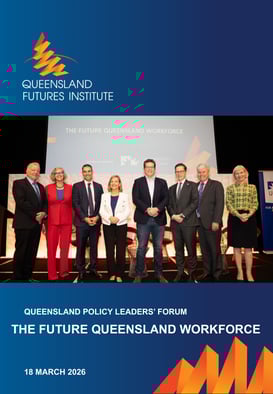
The Future Queensland Workforce forum focused on how the state can attract, develop and retain a sufficiently skilled, resilient and productive workforce, with the conversation moving across productivity, participation, education and training pathways, regional capability, migration and the implications of artificial intelligence. The discussion was framed by the view that many of Queensland’s broader economic ambitions depend on workforce capability and that the task ahead requires stronger alignment across schools, vocational education, universities, employers and government.
A strong consensus emerged that workforce demand is rising while existing systems are under pressure due to strong population growth and soft productivity growth. The discussion also made clear that Queensland’s regional context matters; workforce retention outside the south-east corner was discussed as a structural challenge, and participation barriers affecting underrepresented groups were highlighted as both a social and economic issue.
However, the Panel emphasised that Queensland has strong institutions, growing collaboration across sectors and a significant opportunity to strengthen workforce capability if pathways become more flexible, participation broadens and reform is pursued in a practical and coordinated way.
The effect of AI was another major theme, with the discussion suggesting that future readiness will depend not only on technical literacy but on distinctly human capabilities such as judgement, ethics, critical thinking, collaboration and adaptability.
Proudly Sponsored by:


PANELLISTS:

PROF. HELEN BARTLETT
Vice-Chancellor and President
University of the Sunshine Coast
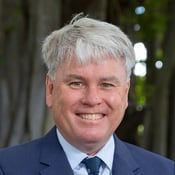
DR PHILLIP MOULDS OAM
Chair
Independent Schools Queensland

TIM RAWLINGS
Chief Executive Officer
TAFE Queensland

ALEX ROBSON
Deputy Chair
Productivity Commission

PROF. DEBORAH TERRY AC
Vice-Chancellor and President
The University of Queensland

MODERATOR:
ROHAN BARRETT
Partner, People Consulting
EY
SUMMARY OF KEY THEMES
- Workforce demand is rising faster than current systems can easily supply. Population growth was described as driving additional demand across healthcare, engineering, IT and related fields, and workforce shortages in these fields are becoming a real concern.
- Productivity is also a key concern and can be linked to workforce capability and living standards. As such, improving productivity should be seen as a key measure noting that output per hour worked in Australia was described as staying at around $110 per hour over roughly a decade.
- Qld’s education and training response must be more flexible and more connected. The discussion emphasised stronger collaboration across schools, vocational education and universities, alongside better recognition of prior learning, clearer credit pathways and more support for lifelong learning.
- The scale of the training task is already substantial, but future qualification needs are expected to grow. By 2050, the vast majority of people under 35 will need either a vocational or university qualification, with degree attainment among young people needing to rise from 45% to 55%.
- Queensland’s regional and dispersed geography is a defining workforce challenge. Place-based institutions and locally anchored pathways are required to attract and retain workers outside the south-east corner of the state.
- Participation and inclusion are part of the workforce solution. The conversation highlighted the need to reduce barriers affecting women returning to work, people with disability, First Nations communities and people in rural and remote areas. This is important for both education and training, and employment outcomes.
- AI is both a disruptor and an opportunity. Generative AI was described as a major disruptor over the next five to ten years, but also as a potential multiplier if used well across work and education. In this context, human capability will matter more, not less; ethical judgement, critical thinking, collaboration, leadership, relational capability will become critical human skills as AI becomes more embedded in work and learning. A key risk of AI to avoid is “cognitive offloading” through over-reliance on AI to replace critical thinking.
- The overall direction of the discussion was toward coordinated, incremental reform. Rather than relying on single large policy fixes, the conversation pointed to the need for many practical improvements across education, migration, labour mobility and workforce participation settings.
Key Themes and Discussion Points
Workforce supply pressures, participation and productivity
The central theme throughout the discussion was that Queensland faces rising workforce demand at the same time as productivity growth remains weak and labour supply is constrained. Population growth was described as increasing demand across healthcare, engineering, IT and related fields. At the same time, productivity has remained soft, with output per hour worked in Australia described as being around $110 per hour a decade ago and still around $110 per hour today. This presents a challenge for living standards and highlights that future workforce capability must be understood not only in terms of worker numbers, but in terms of economic productivity.
The scale of current supply pressures was also highlighted as a key challenge. Jobs and Skills Australia recently released their national occupational shortage list – identifying a shortage in 390 out of 1,022 occupations, and 85% of those shortages concentrated in three areas: trades and technicians, personal and community care and professional roles. This reflects that shortages are a challenge across many sectors in the Queensland economy.
Participation was discussed as part of the same workforce challenge. The conversation highlighted groups who could contribute more strongly to the workforce if barriers were addressed - including women returning to work, people with disability, First Nations communities and people in rural and remote areas. Transport, cost of living and access to education and employment opportunities were cited as practical barriers.
Taken together, the Panel suggested that Queensland’s workforce challenge is not simply about training more people, but about improving participation, lifting productivity and ensuring the right capabilities are being developed across the system.
Education and training pathways need to become more flexible and better connected
The second major theme was the need for a more integrated and adaptable education and training system. Schools, vocational education and universities were discussed as interdependent parts of the same workforce pipeline - with repeated emphasis on stronger collaboration between sectors and closer alignment with industry. The university sector described more flexible program design, embedded practical certifications, joint offerings and work-integrated learning, and ‘step-in/step-out’ study models as examples of how institutions are responding to workforce demand more quickly than in the past.
The discussion also highlighted the scale and diversity of the higher education task. Firstly, universities play a key role in supporting educational and workforce outcomes across the state. For example, the University of the Sunshine Coast supports a student body of about 21,000, with 66% of students coming from equity groups. It has several campuses across Queensland, which provide important anchors for the labour market in outer metropolitan and regional areas. Secondly, the scale of the higher education task in Queensland is considerable; a modelling exercise conducted by Oxford Economics for the University Accord work suggested that by 2050, the vast majority of people under 35 will need either a vocational or university qualification. Of this, the share with vocational qualifications will remain around 30%, and degree attainment among young people will need to rise from 45% to 55%. Currently, degree attainment in Queensland sits around 29% - below the national figure of 34% - and compared to 37% in Victoria and 36% in New South Wales. This will require a significant step change to achieve.
The Panel identified that there is a key opportunity to move from providing an initial qualification towards supporting continual upskilling across peoples’ working life. Lifelong learning, micro-credentials, recognition of prior learning, credit transfer and work-integrated learning were all raised as areas where the current system needs to improve. Occupational licensing is also a key lever – enabling the movement of workers across states. However, it was noted that Queensland has opted out of the automatic mutual recognition program in Australia, which may hinder this.
Overall, the theme was not that education and training pathways are absent - but that they need to be more flexible, more connected and easier to navigate over time.
Regional Queensland requires place-based workforce solutions
Regional and outer-metropolitan Queensland emerged as a distinct and recurring concern throughout the session. The state’s dispersed geography was repeatedly described as a structural challenge - particularly when it comes to attracting and retaining workers outside the south-east corner. This issue cut across schools, vocational education and universities, suggesting that regional workforce pressures affect the full pipeline from education into employment.
The discussion emphasised the importance of place-based institutions and locally anchored pathways – highlighting that if Queensland wants more professionals in regional communities, training needs to occur there, with a pipeline of students being retained in these regions.
A further point was that regional labour markets are less able to absorb shocks than metropolitan economies. Where a single employer or industry experiences a downturn, the consequences can be far more concentrated. This supported the case for more flexible, locally grounded training, including partnerships between institutions and employers in regional areas. The broader implication of this is that regional workforce development cannot be treated as a secondary issue if Queensland wants state-wide resilience and growth.
AI, adaptability and human capability will shape future workforce readiness
Technological change - particularly the rise of generative AI - was one of the strongest cross-cutting themes in the discussion, being described both as a major disruptor and as a potential multiplier of workforce capability. The challenge was framed not simply as technical adoption, but as preparing people to work alongside these tools with judgement, adaptability and care. This will impact both the ways we work and learn – both of which will require not only AI literacy, but consideration of how to use these tools critically and responsibly.
A particularly clear thread in the discussion was that future workers will need to prioritise distinctly human skills. As AI becomes more embedded across sectors, the value of workers will become increasingly focused on ethical judgement, critical thinking, collaboration, leadership and relational capability. The discussion highlighted that education, and training may therefore become more focused on human capacity and the ability to work collaboratively under pressure. Adaptability was also presented as a key capability - both for moving between jobs and for adjusting within the same job as work changes.
The discussion also emphasised the risk of “cognitive offloading” – an over-reliance on technology for thinking itself. The Panel reflected that education and training must ensure that young people understand how to use AI tools, where their weaknesses lie, and that responsibility still sits with the user. In this sense, AI is not a stand-alone technology issue but is part of a larger debate about future workforce readiness, judgement and adaptability.
Workforce policy, migration and system coordination
The final theme was the need for integrated workforce development within the policy system. Education, migration, labour market regulation and industry demand were repeatedly discussed as closely interconnected – and while there is no ‘silver bullet’, there is a clear need for coordinated, incremental reforms across multiple parts of the system.
The policy discussion identified several structural issues, including differing approaches to lesson planning and AI across school systems, limits in harmonisation and credit recognition across education sectors, weak incentives for ongoing training, declining on-the-job training, and occupational licensing arrangements that may inhibit workforce mobility. These issues were presented less as discrete technical problems than as examples of a system that currently makes movement, adaptation and skills development harder than it needs to be.
Skilled migration was discussed as part of this broader system rather than as a standalone solution. Migration settings matter for workforce supply, productivity and for the education sector through international students as a source of future skills. In particular, current migration controls were identified as a key challenge impeding the flow of international students.
The conversation pointed to deeper collaboration with industry as an important part of the response. An important element of this is innovation – which requires industry and the education sectors to come together. A key example of this is the recent cooperative research centre at UQ, which has brought together 62 industry partners, including through a major critical metals hub in WA. This enables a strong relationship between education, training, research and industry outcomes.
In this sense, Queensland has many of the necessary institutional ingredients, but stronger alignment between education, migration, labour market settings and industry demand will be essential. The upcoming Olympics and Paralympics will be a key catalyst for driving workforce development in this way.
Insights and Implications
The discussion suggests that Queensland’s workforce challenge is not a narrow skills shortage issue, but a broader systems issue connecting productivity, participation, education, regional development, migration and innovation. A clear implication from the Panel was that workforce planning cannot be addressed through separate policy approaches; schools, vocational education, universities, employers and government are interdependent parts of the same pipeline and require holistic consideration together.
A second implication is that workforce growth will depend on both scale and flexibility. Given rising demand in many sectors but limits around the workforce pipeline and current education and training pathways, future workforce policy will need to support not only initial qualifications, but continuing reskilling and upskilling across working life, with more flexible movement between sectors and stages of education. Migration must also be considered alongside this pipeline – as an important source of skilled workforce and international students.
Regional capability also emerged as central to Queensland’s workforce future. The discussion made clear that a dispersed population changes how workforce issues are experienced across the state, and that regional labour markets cannot simply rely on metropolitan supply. Place-based education, regional delivery models and stronger local partnerships were all presented as important to building and retaining labour markets outside the south-east corner.
Another key implication concerns participation and inclusion. The conversation did not treat inclusion only as a social equity issue, but as an economic necessity. The discussion indicated that Queensland’s future workforce capacity will depend in part on reducing barriers faced by underrepresented groups and by communities with lower participation and educational attainment. This suggests that workforce growth depends not only on expanding supply, but on widening access to education and employment opportunities.
Finally, AI and technological change are reshaping how we work and learn. Future workforce capability will require more than digital literacy alone. Educators and employers need to place greater value on human capability alongside technical competence – by supporting their students and workforces to continue to use ethical judgement, critical thinking, collaboration, relational capacity and leadership skills.
Conclusion
The discussion reinforced that the evolution of Queensland’s workforce will be shaped by demographic pressures, persistent skills shortages, regional labour market constraints, technological disruption and the need to lift productivity. The central takeaway was that no single institution or policy lever can resolve these issues in isolation; overcoming these challenges will require a more connected system in which schools, vocational education, universities, employers and government each play complementary roles in building the future Queensland workforce.
FULL EVENT REPLAY: