| |
|
Queensland’s financial services sector: scale, ambition and opportunity
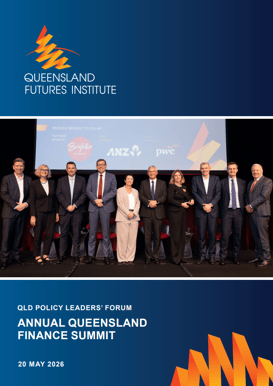
- The forum opened with a clear statement of ambition: Queensland has the institutional foundations to become a leading national centre for financial services. The combined balance sheets of superannuation funds, investment managers, insurers, challenger banks and government financing bodies represented on the panels amounted to close to $800 billion in assets under management or investment. A significant share of this capital is deployed in Queensland.
- Speakers noted that this concentration of capability is not widely appreciated, including within Queensland itself. The sector’s strength is distributed across fund management, corporate banking, insurance, retirement products, government financing and emerging fintech activity. Brisbane increasingly functions as a genuine financial hub, with a deepening talent base, professional services ecosystem, and significant institutional capabilities that can support continued growth.
- The ambition is no longer merely aspirational. Queensland’s emergence as a financial services centre is taking shape, and the evidence is visible in the calibre and scale of the organisations represented at the forum. The task now is to accelerate momentum, close capability gaps and ensure the conditions are in place to retain talent and attract capital and translate institutional scale into long-term economic advantage.
|
|
Talent, the Next Gen Finance Network and keeping Queensland’s best at home
|
- Talent retention was identified as one of the most important structural challenges facing the sector. Research conducted by the QFI found that while 85% of Queensland finance and commerce students aspire to a career in financial services, only 45% expect to remain in Brisbane over the coming decade. The pull of larger institutions, higher-profile roles and established career pathways in Sydney and Melbourne continues to draw emerging talent away from Queensland.
- The Next Gen Finance Network was launched in response to this challenge. Established through the QFI’s Finance Council and supported by six founding organisations – ANZ, Australian Retirement Trust, Brighter Super, QIC, Queensland Treasury Corporation and Suncorp – the network provides high-potential graduates and early career professionals with cross-firm learning, executive exposure and mentorship. Its central proposition is that an ambitious finance career can be built and sustained in Queensland.
- Speakers drew on personal experience to reinforce the point. The value of formative professional experience in Queensland was described as career-defining, and several leaders traced their current roles directly to opportunities they had found locally. The message was consistent: the opportunities exist, but the sector must make them more visible, credible and compelling for the next generation of financial services talent.
|
|
Banking, digital transformation and preserving the human connection
|
- The first panel examined how financial institutions are navigating the relationship between digital efficiency and human connection. There was broad consensus that this is a false binary. Digital channels now handle the overwhelming majority of everyday transactions. For example, cash has fallen from 70% of retail purchases pre-COVID to around 13-14% today. But the most consequential customer interactions still depend on skilled, empathetic human engagement.
- Examples included supporting customers through bereavement, identifying and assisting vulnerable individuals before they reach crisis, managing complex financial transitions and serving regional and remote communities where personal relationships carry particular weight. AI and data capabilities were seen as tools that enhance rather than replace human judgment – enabling early intervention, identifying patterns of distress and freeing up staff to focus where human contact matters most.
- Speakers also noted the generational dimension of the shift. Younger customers regard friction in digital banking as a service failure. Banks that cannot offer simple, intuitive mobile experiences are no longer in the consideration set. At the same time, investment in digital must be balanced against scam and fraud prevention, regulatory compliance, branch presence in underserved communities and the ongoing requirement to serve customers who are less comfortable with technology.
- Regional banking access was raised as a specific consideration. Partnerships with Australia Post, fee-free ATM networks and brokers with regional distribution all play a role. More broadly, the panel emphasised the importance of combining digital scale, physical presence, partnerships and data-led foresight to meet customer needs across Queensland’s diverse communities.
|
|
Insurance, climate risk and the evolving challenge of resilience
|
- The insurance sector faces a convergence of pressures: rising climate-related claims, the increasing cost and complexity of general insurance in Queensland, a surge in mental health claims in life insurance, and the challenge of maintaining affordable, accessible cover across a population with highly varied risk profiles and financial circumstances.
- Research presented at the forum indicated that over half of Queensland’s energy assets face high climate impact risk within the next two decades. The state’s exposure to severe weather was also underscored by the fact that 60% of cyclone pool properties are located in Queensland, reinforcing the need for coordinated action between government, insurers and communities to strengthen resilience and maintain access to affordable cover.
- Health risk was identified as a related pressure. Around a quarter of Queenslanders were described as being at higher risk or experiencing low health, while mental health claims have increased sevenfold for people in their thirties over the past decade, and now account for around 20% of life insurance claims at some providers. Some current product design, particularly in TPD, was identified as poorly suited to conditions that may be treatable or time-limited, because it can embed permanency and reward long-term impairment. Significant product innovation will therefore be required to overcome this.
- Personalisation was identified as a key direction across both general and life insurance – driven by advances in medicine, data and digital technology. The move from pooled risk to more granular, individual-level risk assessment raises important questions about inclusion and affordability that the sector and government will need to navigate.
|
|
Retirement income, superannuation and the age of ageing
|
- Australia’s superannuation system was described as a world-class accumulation engine that has not yet fully adapted to its next challenge: converting accumulated wealth into sustainable retirement income. The system was designed largely as a hands-off institutional savings vehicle, with much of the risk transferring entirely to the individual at the point of retirement. For many Australians, retirement is not a planned event but something that happens to them – through health, workplace injury or redundancy – often without adequate preparation.
- Queensland faces this challenge at scale. The state’s population of over-65s is projected to grow by 80% over the next 15-20 years, against 20% growth in the 0-14 cohort. Queensland also receives significant net interstate migration, much of it from retirees, making the design of retirement income solutions a particularly acute priority for the state.
- Technology was identified as the most likely path to democratising access to retirement advice. With only around 15,000 financial advisers remaining in Australia – and access to advice expensive and fragmented – the sector cannot rely on traditional advice models to serve the 2.5 million Australians expected to retire in the next decade. Technology-enabled platforms capable of delivering personalised, episodic advice at scale are already operational in other markets, and panellists expressed confidence that similar capability will be available in Australia within three-to-five years.
- Product innovation is also advancing. Guaranteed income products, bucket strategies that balance liquidity with long-term growth, and super fund advice platforms were all cited as examples of the sector’s response to the retirement income challenge. The shift from accumulation to decumulation is also changing what institutional investors need to offer: more liquidity, more yield-based products and more direct engagement with members around their individual circumstances.
Capital investment, infrastructure and Queensland’s long-term opportunity
- The second panel focused on the deployment of long-duration capital into Queensland’s infrastructure and energy transition. Australia’s superannuation funds are already among the largest institutional investors in the world, currently ranked fourth globally and projected to be second only to the United States by 2031. Queensland’s own institutional capital base – including QIC, Australian Retirement Trust, Brighter Super and QTC – is a significant and growing force in both domestic and international markets.
- Capital flows on a relative basis, and Australia’s economic resilience and Asia-Pacific positioning mean it consistently clears the initial hurdle for global allocators. Within Australia, Queensland is increasingly on the agenda. The scale of the state’s energy transition investment pipeline – estimated at around $60 billion over the next five years – is material to global capital allocators and well-suited to the long-duration mandates of infrastructure investors.
- Queensland’s northwest is a region of particular strategic significance, with $700 billion in critical minerals in the Northwest Minerals Province, the CopperString transmission line connecting Townsville to Mount Isa, and a $200 million Northwest Energy Fund managed by QIC to support bespoke energy solutions for critical minerals projects. The Eva Copper development, representing a $2.3 billion investment, was cited as a signal of the private capital that can be mobilised when conditions are right.
- The relationship between government and private capital is central to realising this opportunity. Government cannot fund the full pipeline from its own balance sheet, and private capital requires clear frameworks, accessible entry points and credible long-term signals. Institutional investors with deep Queensland roots – including QIC and Australian Retirement Trust – were described as having a comparative advantage in navigating this partnership, given their existing relationships and local market knowledge.
- Importantly, Queensland Treasury Corporation plays a critical role in attracting offshore capital. With around $170 billion on issuance in the Australian dollar market, QTC is a significant borrower operating in highly volatile global conditions. Timing, diversification across investor pools, euro issuance and Queensland’s standing as the largest issuer of sustainable bonds in Australia were all identified as levers for maintaining competitive cost of funds. Global market instability, reflected in diversification away from the United States, is creating opportunities for Queensland to capture new offshore capital.
Productivity, the Productivity Commission and the decade ahead
- Productivity is a cross-cutting priority for Queensland. The reestablishment of the Queensland Productivity Commission provides a foundation for systemic reform, with its 458-page report and 64 recommendations representing a substantial reform agenda. Early productivity indicators are moving in the right direction, but the pace needs to accelerate.
- Within financial services specifically, productivity improvements are being driven by technology, automation, digital tools and AI – reducing friction in routine transactions, enabling earlier identification of customer needs and freeing up human capacity for higher-value work. The challenge is ensuring that these gains translate into tangible improvements in customer outcomes, not just cost reductions.
- Productivity is also linked to the broader investment environment, with a clear need for reforms to reduce barriers to investment, improve supply and maintain policy settings that support business growth through the decade ahead.
The 2032 opportunity and what it demands of the sector
-
The decade ahead presents an extraordinary opportunity for Queensland, and the financial services sector has both the capability and the responsibility to help realise it. The 2032 Olympic Games are not just the centrepiece of this opportunity, but can serve as a catalyst for a longer and deeper transformation – encompassing generational infrastructure investment, population growth, regional development, the energy transition and the maturation of Queensland’s institutional financial ecosystem.
-
Capturing this opportunity will not happen automatically. It requires deliberate choices around talent retention, capital deployment into Queensland rather than simply managing it from here, designing financial products that serve the full spectrum of Queenslanders, and building the cross-sector relationships and shared infrastructure needed to realise the state’s ambitions.
|
|
Insights and Implications
|
- Queensland’s financial services challenge is not primarily a question of capability or scale – both are present and growing. The more pressing question is whether the sector can leverage structural advantages into deliberate, coordinated outcomes.
- Talent is the sector’s most important near-term lever. Without a pipeline of skilled, ambitious professionals who choose to build their careers in Queensland, the sector’s long-term ambitions will be constrained. The Next Gen Finance Network is a meaningful start, but the sector will need to continue investing in visibility, mentorship, career pathways and the conditions that make Queensland-based careers genuinely compelling.
- The retirement income challenge is structural and urgent. As Queensland’s population ages and the ratio of retirees to working-age residents shifts, the financial services sector will need to serve a much larger and more complex retirement cohort. Product design, access to financial advice, technology and member engagement all need to evolve - and the window for doing so in a planned, deliberate way is narrowing.
- Climate risk is a financial risk that must be priced, managed and mitigated collaboratively. The rising cost of insurance in Queensland, the exposure of infrastructure assets and the vulnerability of a significant proportion of the population are not abstract concerns. They require sustained engagement between the financial sector, government and communities – not just at the level of individual products, but at the level of investment in resilience, land use and infrastructure.
- The energy transition and critical minerals opportunity demands a partnership model. Queensland has the resources, the institutional capital and the government intent to be a significant player in the global energy transition. But realising that potential requires deep, strategic alignment between public and private capital. The structures being put in place – including the investor gateway, the Northwest Energy Fund and the CopperString transmission line – are meaningful steps. The sector’s role is to engage actively with these frameworks rather than waiting for conditions to mature.
- Digital transformation is not a destination but a continuous investment. The pace of change in technology, customer expectations and competitive dynamics means that institutions that do not invest consistently in digital capability risk falling behind. At the same time, the human dimension of financial services is not diminishing – it is being concentrated in the interactions that matter most.
|
|
Conclusion
|
-
The Queensland Finance Summit reflected a sector that is confident about its foundations but clear-eyed about what it must do differently. Queensland has the institutional depth, capital scale, geographic position and reform momentum to become a genuinely leading financial services centre. The conditions are more favourable than they have been in decades.
-
What distinguishes this moment from previous cycles is the convergence of forces: demographic change, technological disruption, the energy transition, population growth and the runway to the 2032 Olympics. The sector’s task is not to manage these individually, but to connect them – the talent that will deploy the capital, the advice that will serve the retirees, the technology that will make services accessible, the infrastructure that will underpin the growth.
-
The forum demonstrated that Queensland’s financial services leaders understand the scale of the opportunity and are committed to playing a central role in shaping what comes next.
|