
The Rethinking Queensland’s Health Future panel discussion brought together senior leaders from across the health system to examine how Queensland can build a healthier future for all its residents. The discussion featured perspectives from hospital management, public health and wellbeing, pharmacy and the pharmaceutical industry, exploring what is working, what ‘prescriptions for change’ are needed, and what optimism looks like in the face of serious structural challenges.
A central theme was the importance of designing care around the patient rather than institutions. The discussion highlighted the gap between where people want to receive care and where the health system currently delivers it. Delayed transitions to care, healthcare workforce constraints, food insecurity in remote communities, and the growing burden of obesity and chronic disease were among the key challenges examined.
The discussion identified practical, evidence-based initiatives already generating measurable improvements – such as specialised dementia units, community pharmacy initiatives and remote food security programs.
Proudly Sponsored by:

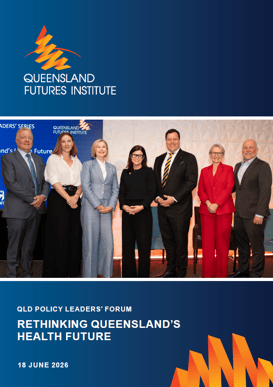

PANELLISTS:

NOELLE CRIDLAND
Health Service Chief Executive
Metro South Health

DR ROBYN LITTLEWOOD
Chief Executive Officer
Health and Wellbeing Queensland

CHRIS OWEN
Branch President
The Pharmacy Guild of Australia, Queensland

DR ANA SVENSSON
Senior Director, Medical, Regulatory PV
Novo Nordisk Oceania

MODERATOR:
SARAH ABBOTT
Partner Health, Ageing & Human Services
KPMG
SUMMARY OF KEY THEMES
- Delayed transitions to care are placing serious pressure on Queensland’s hospital system, with over 300 people at Metro South Health alone occupying beds they no longer clinically need, contributing to emergency department bottlenecks and patient harm.
- Designing care around what patients want - including ageing at home and receiving palliative care in familiar surroundings - must guide system redesign, rather than the institutional logic that has historically driven hospital planning.
- Queensland’s children in rural and remote areas face serious health disadvantages, including food insecurity and limited access to affordable fresh food and shorter projected life expectancy, but targeted community-based interventions are producing measurable improvements.
- Pharmacist scope of practice reforms have expanded access to primary care in Queensland, with around 1,000 pharmacists expected to be in the pipeline by end of year, demonstrating what well-designed, evidence-based workforce reform can achieve.
- Obesity and type 2 diabetes represent a growing economic as well as public health crisis, costing an estimated $39 billion annually, with projections suggesting this could rise to $90 billion within a decade without stronger prevention, earlier intervention and more equitable access to evidence-based care.
- Multidisciplinary, whole-of-community approaches are essential: no single profession, treatment or program will shift the dial on chronic disease without coordinated effort across clinical, community, government and industry partners.
- Technology and remote monitoring offer significant opportunities to move care closer to patients in their homes, supporting community-based care, reducing avoidable outpatient visits and enabling earlier identification of deterioration.
Key Themes and Discussion Points
Delayed Transitions to Care and the Demand for Hospital Beds
- The panel opened with an examination of one of Queensland’s most pressing health system challenges: the large number of patients who remain in hospital because they cannot transition to appropriate home, community, residential or aged care settings. At Metro South Health alone, more than 300 patients occupy beds they do not clinically require, while people in genuine need wait in emergency departments. Across Queensland, the most recent census counted approximately 1,400 such patients statewide.
- These patients - often older Australians, people living with dementia, or NDIS participants – are not problems to be managed, but people deserving of care delivered in an environment suited to their needs. Acute hospitals, designed for episodic clinical intervention, are often the worst possible place for someone whose needs are residential rather than medical. This can contribute to deterioration when people are unable to maintain their health in an appropriate environment.
- People with complex behaviours associated with dementia, those classified as concessional residents, smokers and individuals with obesity or other complicating conditions are less likely to be accepted by aged care providers. This means the highest-need patients are the ones who tend to remain in hospital and present the greatest transition challenge, often remaining in an unsuited healthcare environment.
- Practical solutions presented included a ‘home first’ approach, focused on safely returning patients to their own homes wherever possible rather than defaulting to residential care. This reflects patient preference, with the panel noting that four out of five people responding to the aged care royal commission said they wanted to age at home. Other solutions included Metro South’s Care Pack team, which is undertaking research on how to support successful transitions into aged care, including how to reduce returns to emergency departments within three months, where around 80 per cent of those returning patients are admitted; and dedicated acute cognitive units providing expert, environment-appropriate care for patients with dementia. Specialist dementia care environments and trained staff can fundamentally change patient trajectories, reducing occupational violence and enabling successful transitions that might otherwise be impossible.
Children’s Health and Food Security in Regional and Remote Queensland
- The discussion moved to the health of future generations, with particular attention to the stark disparities between Brisbane and regional and remote Queensland. Median age of death varies from around 82 in parts of Brisbane to 74 in Roma and as low as 52 in parts of the far north. One in three homes in the far north lacks enough food to last a single day. Fresh food can take up to eight days to reach remote communities, often having travelled thousands of kilometres.
- Children born in Queensland from 2023 onwards are projected to live shorter lives than their parents – a reversal of longstanding progress that reflects the cumulative impact of poor food security, high food costs, limited access to fresh, and healthy food in some communities.
- To address this challenge, Health and Wellbeing Queensland has developed a ‘stacking’ model that integrates school-based, community, retail, farming and government initiatives. One program, Pick of the Crop, has now reached 287 Queensland schools and 54,000 children, connecting students with growing, preparing and eating fresh vegetables in ways that measurably increase consumption. A separate partnership with Community Enterprise Queensland is improving the healthiness and product placement in 21 remote stores, achieving a 10.7 per cent improvement in purchasing behaviour. Additionally, a government-funded remote freight subsidy scheme has produced a 24 per cent reduction in food costs across 25 stores in northern Queensland.
- Together, these initiatives represent a coordinated effort to improve food access, reduce cost and change behaviour at scale. Panellists emphasised the importance of involving farmers, retailers, schools, families, truck drivers and industry in the solution, rather than relying on any single lever.
Workforce Reform and Pharmacist Scope of Practice
- The panel examined the challenge of making better use of the existing health workforce at a time when demand is outpacing supply across the health system. While workforce pipeline growth is important, the more immediate lever is removing the legislative, regulatory and funding barriers that prevent health professionals from practising to the full extent of their training and competence.
- Queensland has led nationally in expanding pharmacist scope of practice, building on international evidence from New Zealand and elsewhere. A North Queensland community pharmacy pilot covering 23 conditions – including urinary tract infections, hormonal contraception, skin and ear presentations, blood pressure and diabetes-related care – has now seen the majority of those services made permanent, with other states and territories following Queensland’s model. After just four years, Queensland expects to have around 1,000 pharmacists in the expanded-scope pipeline by the end of the year. In contrast, New Zealand, which implemented similar reforms 15 to 16 years earlier, only has 24.
- This reflects the critical need to address latent and unmet demand. Patients in North Queensland were not avoiding care but simply had no timely access to it. When pharmacists were empowered to treat a broader range of conditions, latent demand was brought into the system, patients had another entry point to care and referral pathways into other parts of the health system were strengthened. This reform was enabled by early data, quality frameworks, clinical governance, training, safety mechanisms and reporting arrangements.
- Queensland’s experience shows that expanded roles are most effective when they are supported by strong clinical governance, quality and safety frameworks, training, reporting systems, IT infrastructure, indemnity arrangements and active change management. The broader prescription for workforce reform is therefore not simply to remove legislative barriers, but to pair that reform with the funding, systems and safeguards needed to allow all health professions to practise safely and effectively to their full scope.
Obesity, Chronic Disease and the Case for Systemic Reform
- The final panel contribution addressed the scale of the obesity and type 2 diabetes challenge nationally and across the APAC region, with specific implications for Queensland communities and workforces. With 1.5 million Australians living with type 2 diabetes and 13 million who are overweight or living with obesity, the burden is already significant. The economic cost is estimated at $39 billion annually, with projections suggesting it could rise to $90 billion within a decade. In some industries, obesity-related impacts were described as costing up to $70 million per 1,000 workers annually.
- A key structural problem is that Australia’s health system remains predominantly focused on treatment rather than prevention, and access to evidence-based care - including pharmacological treatments – remains limited despite high clinical need. The panel emphasised that addressing this imbalance requires engaging government, industry, primary health networks and communities simultaneously, not sequentially.
- Recognising obesity as a chronic disease rather than a lifestyle choice is a foundational policy step. From this recognition, policymakers can prioritise improving equitable access to the full care pathway from early childhood to old age; generating local data and evidence to support policy change; reducing stigma; strengthening early detection and early intervention; and mobilising private-public partnerships to support prevention and care at scale.
- GLP-1 receptor agonists and other emerging treatments play important roles in metabolic care, but panellists made clear that pharmacological innovation represents only one part of the solution. Sustainable improvement in metabolic health requires behavioural support, community environments that enable healthy choices, physical activity, multidisciplinary care teams, access to innovative treatments, and long-term system settings that support prevention and early intervention. In short, no single intervention will shift the dial; treatment, community, prevention, industry, pharmacy, food and physical activity all need to work together.
Insights and Implications
- Queensland’s health challenges are not uniform. They are concentrated in particular populations, geographies and life stages - and addressing them requires targeted, place-based, cross-sector responses rather than system-wide policies applied uniformly.
- The most effective interventions discussed shared common characteristics: they were designed around the patient or community perspective, they engaged communities as partners rather than recipients, they produced data, evidence or measurable program experience, and they worked across organisational and sectoral boundaries rather than within them.
- Technology and remote monitoring offer an important opportunity to shift care closer to where people live. Whether through community pharmacy, remote health monitoring, school-based food programs or store placement nudges, the examples presented demonstrate that meaningful change does not always require large capital investment - but it does require sustained attention, practical implementation support and system backing.
- Workforce reform, particularly expanding scope of practice across all health professions, represents a practical and relatively immediate lever for improving access to primary care. The Queensland pharmacy model is already demonstrating what is achievable when training, regulation and funding settings are aligned.
- The chronic disease burden, particularly from obesity and type 2 diabetes, will not be addressed without significant policy shift. The current focus on treatment over prevention, combined with limited access to evidence-based care, is producing costs that will compound over time without deliberate intervention. Stronger preventive health policy settings, backed by cross-sector investment, public-private partnerships and evidence-based program design, are essential.
Conclusion
- The forum made clear that optimism about Queensland’s health future is well founded. It is grounded in the real achievements of clinicians, public health practitioners, community organisations, industry partners and policymakers who are already making a difference.
- What is needed now is the institutional will, policy support and delivery discipline to take those achievements to scale, to redesign care around the patient, to remove the regulatory and funding barriers that hold the workforce back, to invest in prevention with the same rigour as treatment, to treat food security, prevention, workforce participation, community wellbeing and health as connected rather than siloed policy domains.
- Queensland has the talent, the innovation and the evidence. The state’s health future will be shaped not simply by the scale of the challenges it faces, but by how effectively it supports, scales and sustains proven, patient-centred and community-based reforms.
FULL EVENT REPLAY: